Destination guide · Updated August 2026
Study Spanish in Ibiza, a 2026 guide
Above the port, a walled old town climbs a hill in tight stone lanes. That is Dalt Vila, and it is the clearest clue to what kind of place Ibiza actually is. The island capital holds around 51,000 people, small enough that the historic core and the modern port sit within a short walk of each other. It also carries a UNESCO World Heritage listing for that old town, and a reputation as one of the world's best-known clubbing destinations.
That combination of heritage by day and a global club scene by night sets it apart from a typical Spanish city break. The old town, the port and the nearby beaches are close enough to move between on foot, and Formentera is a short ferry ride away for its own beaches, coves and a slower pace. The same nightlife identity that draws so many visitors also keeps the streets around the port loud into the small hours and pushes daily costs above the Spanish average.
Day to day, most of student life folds into this scale: class finishes, and the sea, a market stall or a terrace are only minutes away. Evenings often drift toward the port, where bars and restaurants stay busy well past dinner. English is widely understood in the tourist and nightlife zones, so you will not be forced into Spanish just by walking around. Real practice means deliberately choosing markets, family-run bars and everyday errands over the English-speaking strip. It suits students who want their language trip built around beach time, market mornings and a genuinely lively social scene after dark.
Ibiza at a glance
Closest airport
Ibiza (IBZ)
- Region
- Balearic Islands
- Setting
- Compact capital on the island's coast
- Known for
- UNESCO old town and famous nightlife
City size compared to other cities in Spain
55,337 inhabitants
- Ibiza: 55337
- Palma de Mallorca: 434786
- Valencia: 840792
- Alicante: 366221
- Madrid: 3506730
- Barcelona: 1731649
- Seville: 689423
 Ibiza suits you if
- Want beach life and nightlife together
- Enjoy exploring a walkable historic old town
- Enjoy meeting travellers over drinks at the port
- Are comfortable with higher island living costs
- Want water sports and coastal excursions nearby
- Welcome hearing Catalan and Spanish daily
Spanish language schools in Ibiza
One school offers Spanish courses in Ibiza. Prices, reviews and what the school is like are below.
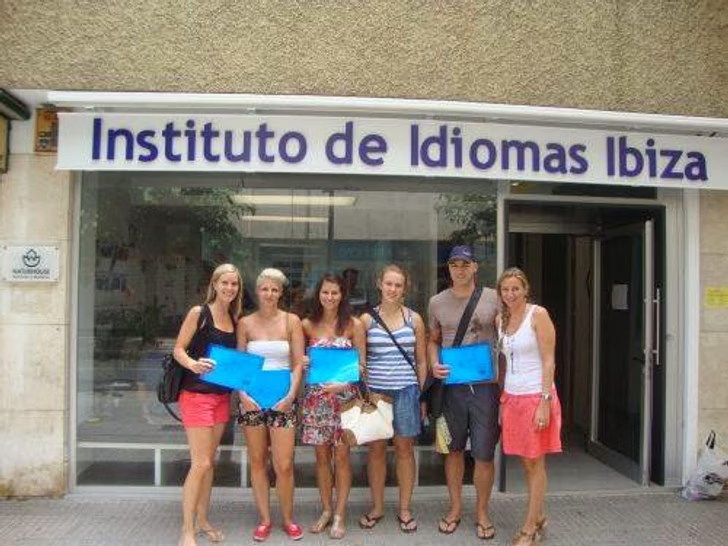
Instituto de Idiomas Ibiza
9.2- Max. 10 per class
What students say about studying in Ibiza
Students who study here keep coming back to the same thing: the setting. The walk up into Dalt Vila, the fortress streets opening onto views of the port and the water below, the sense of finishing class and stepping straight into scenery most people only see on a screen. It is the surroundings, not any single lesson, that stay with people.
Studying inside a UNESCO old town on a small island does that. The rest, nightlife noise, the cost of eating on the waterfront, is worth weighing before you book, but it is not what students mention when they talk about their time here.
Commonly praised
- Idyllic surroundings in Ibiza
Weekend trips from Ibiza
Ibiza Town works as a base for the rest of the island and beyond. A short ferry gets you to Formentera for a slower, sand-and-clear-water day. Buses reach the other coastal towns: Santa Eulària des Riu on the east coast, Sant Antoni de Portmany on the west, and the quieter villages inland and to the north, including Sant Joan de Labritja and Sant Josep de sa Talaia. Ses Salines Natural Park, with its salt flats and protected dune beaches, is also within reach on the same bus network. Which of these run and when depends on your school's calendar, the season and your travel dates, though several, the Formentera ferry especially, are just as easy to arrange on your own.
Places students often explore
Life around the old town and the port
Everyday life in Ibiza Town folds into a tight loop. Dalt Vila sits on its hill above the harbour, La Marina spreads along the water below the walls, and the shopping axis of Paseo de Vara de Rey links both to the newer grid inland. None of it takes long to cross on foot. The old town's cobbled ramps lead down to the port in a few unhurried minutes, and Ses Figueretes, with its own stretch of sand, is a short walk further south. Day to day you will rely more on your legs than on wheels.
For anything further, city bus line 10 threads together the bus station, the old town, the port and San Jorge, and it is the workhorse for errands beyond walking distance. Taxis fill the gaps once the buses stop for the night. The social scene after class tends to spill onto the terraces around the port and La Marina, where locals, seasonal workers and travellers from across Europe end up sharing the same tables. At markets like Mercat Nou you find that same mix up close, buying vegetables alongside someone who has lived here for decades and someone who arrived last week. The everyday infrastructure, the markets, buses and local services, holds up well if you plan to stay more than a few weeks.
Getting to know the neighbourhoods
Dalt Vila
The walled UNESCO old town, stacked up Puig de Vila hill with the cathedral and fortress walls at the top. Its steep lanes and viewpoints are a short climb on foot from the port.
La Marina
The harbourfront quarter directly below Dalt Vila's walls, lined with cafés, bars and restaurants. This is where the port's social scene concentrates in the evening.
Paseo de Vara de Rey
The central shopping axis connecting the old town to the modern grid, useful for everyday errands and a natural meeting point between the historic core and newer Ibiza Town.
Ses Figueretes
A neighbourhood south of the centre with its own urban beach, reachable on foot from the old town. A quieter base with the sea close by.
Platja d'en Bossa
A beachfront stretch built around clubs and beach clubs, separate from the compact walkable core where the old town, port and schools sit. You reach it by bus or taxi rather than on foot, so it works as an evening or weekend outing rather than a daily stop.
What everyday student life looks like
- Dalt Vila's cobbled ramps connect the old town to the port on foot in a few minutes
- City bus line 10 links the bus station, old town, port and San Jorge for daily errands
- Cafés, bars and restaurants cluster around the historic centre and the port for life after class
- Locals and tourists mix at markets like Mercat Nou and along the waterfront
- Ses Figueretes puts a stretch of sand and a swim within easy walking distance for a break between classes
- Markets, buses and everyday local services make the city a workable base for longer stays
Catalan, Spanish and Eivissenc in Ibiza
Two languages share official status here: Spanish and Catalan. What you hear on the street is usually Eivissenc, the island's own variety of Catalan, with vowel sounds that differ noticeably from the Catalan spoken in Barcelona. Street signs and market stalls often carry both languages side by side.
Ibiza's economy runs on tourism, and English is widely understood around the port, in restaurants and across the nightlife districts. That makes daily life easy, but it also means Spanish will not reach you automatically just by being here. Order your coffee, ask for prices and chat with stallholders at Mercat Nou or Mercat Vell in Spanish instead. Vendors there deal with locals as much as visitors, so when you keep speaking Spanish they tend to answer in Spanish too, which gives you real, unscripted conversation practice.
What a week in Ibiza costs
from
€ 360 / week
Course + room at the same school, for a 2-week booking. Excluding flights.
Courses
per week, from- General Long Term Courses 20 group lessons a week, from 25 weeks
- € 175
- General Courses 20 group lessons a week
- € 240
- General + Focus Courses 20 group lessons a week
- € 240
- Bildungsurlaub 23 group lessons a week
- € 335
- General + Private Courses 20 group lessons a week, plus 4 private lessons
- € 360
- Family Courses 10 group lessons a week
- € 450
Accommodation
per week, from, own room- Shared Apartment own room
- € 185
- Host Family own room, breakfast included, shared bathroom
- € 340
From-prices apply to a 2-week booking outside high season. Book longer and the weekly price drops. Registration fee and materials are not included.
Living costs in Ibiza run above the mainland Spanish average, and the reason is straightforward: it's an island, so much of what fills the supermarket shelves has arrived by boat or plane, and that pushes grocery and everyday shopping prices higher than you'd find in Valencia or Seville. Shopping at Ibiza Town's produce markets keeps things more reasonable than the supermarkets aimed at holidaymakers. A menu del dia at a neighbourhood restaurant away from the waterfront is still good value next to a seafront table with a harbour view.
Where you really feel the island premium is transport and evenings out. Local buses are the cheaper way to get around town and across the island, while taxis, especially late at night or straight from the airport, cost considerably more. The same logic applies to your social life. Cook for yourself, eat where locals eat and take the bus, and your daily spend stays reasonable. Add beach clubs, waterfront dinners and taxis home after a club night, and your spending depends directly on how much of that nightlife and beachfront scene you choose to take part in.
Things to do in Ibiza
Outside class hours, most students split their time between the old town, the markets and the water. Climb up into Ibiza's walled fortress quarter, Dalt Vila, and you reach the cathedral and the Punic necropolis of Puig des Molins. A short walk further takes in a handful of small museums, among them the Archaeological Museum of Ibiza and Formentera and the Museum of Contemporary Art. Down at street level, Mercat Nou and Mercat Vell are where you can pick up fresh produce and try local dishes such as bullit de peix, sofrit pagès or a slice of flaó straight from the stalls.
How many of these you get to depends on your school, the season and your own dates, though several are easy enough to arrange yourself. Paddleboards, snorkels and kayaks are simple to hire by day, and come evening the terraces around the port fill with a genuine mix of locals and travellers.
Inside the fortress walls, you can walk to the cathedral, the Punic necropolis of Puig des Molins and a run of small museums, including the Archaeological Museum of Ibiza and Formentera, the Museum of Contemporary Art (MACE) and the Puget Museum.
Mercat Nou and Mercat Vell are the city's produce markets, stalls of fresh fish, vegetables and local cheeses, and a good place to start tasting dishes such as bullit de peix, sofrit pagès, greixonera or a slice of flaó.
Paddleboarding, diving, swimming, snorkelling and kayaking are all easy to arrange, and boat trips run along the coast. The sunset viewpoints and coastal walks make a natural way to end a day of studying.
Instituto de Idiomas Ibiza runs a guided walking tour of Ibiza Town, a visit to the ancient Necropolis, a Spanish pronunciation workshop and a cooking class where you make paella and gazpacho, alongside chances to meet classmates from different countries over these shared activities.
Terraces around the port and Dalt Vila draw a steady mix of locals and travellers, and browsing the markets doubles as low-key socialising. Patron saint celebrations and craft markets such as the hippy markets are worth timing an evening around if your dates line up.
Best time to study in Ibiza
Summer here means proper heat: July averages 30°C by day and August reaches 30.6°C, with the sea sitting at 25 to 26°C. July averages no rainy days at all. It is also when the island is at its busiest and loudest, so if you are coming for the club scene and beach clubs alongside your course, this is your window. If you would rather see Ibiza's old town and coastline without the peak crowds, June or September offer nearly the same swimming conditions (sea temperatures of 22°C or higher), fewer rainy days than the shoulder months either side, and a calmer pace once the biggest summer crowds thin out.
Spring (April to May) is milder and drier than winter, good for walking Dalt Vila's ramps and exploring the coast without heat fatigue, though the sea is still cool for swimming. Winter (December to February) is the quietest option, with daytime highs of 16 to 17°C, mild but too cool for most beach days. The sea drops into the mid-teens and rainy days pick up slightly, so winter suits students who want a calmer, heritage-focused stay rather than beach time.
Month by month
| Month | Avg high | Avg low | Sea temp | Rainy days |
|---|---|---|---|---|
| January | 16.1°C | 7.8°C | 15°C | 5 |
| February | 16.1°C | 7.8°C | 13.9°C | 4 |
| March | 17.8°C | 9.4°C | 15°C | 4 |
| April | 20°C | 11.7°C | 16.1°C | 4 |
| May | 23.3°C | 14.4°C | 17.8°C | 3 |
| June | 27.2°C | 18.3°C | 22.2°C | 1 |
| July | 30°C | 21.7°C | 25°C | 0 |
| August | 30.6°C | 22.2°C | 26.1°C | 2 |
| September | 27.8°C | 20°C | 25°C | 4 |
| October | 23.9°C | 16.1°C | 22.2°C | 6 |
| November | 19.4°C | 11.7°C | 18.9°C | 6 |
| December | 16.7°C | 8.9°C | 16.1°C | 6 |
Getting to Ibiza and around the island
Ibiza Airport (IBZ) sits 7.5 km south of the town, on the southern side of the island. A taxi to accommodation in Ibiza Town takes about 10 minutes. The AERO 3 airport bus covers the same route in about 20 minutes, costs less, and still handles a suitcase or two without trouble.
Once you are settled, the old town and port are compact enough to cover on foot, and daily errands rarely require transport at all. For trips further afield, an island-wide bus network connects the town with the airport, the port and towns such as Santa Eulària des Riu and Sant Antoni de Portmany. It runs reliably during the day, but once the last buses stop, taxis are the practical way home from the port or nightlife areas.
Getting there: common questions
Is Ibiza safe? What students should know
Ibiza is generally considered safe for students, especially during the day. The old town's fortress streets and market squares see a steady mix of locals and visitors, and daytime life around Dalt Vila and the port carries little more risk than any other popular coastal town. Once night falls and the port and club districts fill up, it is worth being more deliberate: stay with people you know, keep your bag zipped and your phone out of your back pocket, and use a licensed taxi rather than walking home alone.
The main thing to watch for is petty theft. Pickpocketing and phone or bag snatching pick up around clubs and the busier stretches of the waterfront, especially once the crowds thicken after dark. Ibiza's port area and La Marina stay lively well past midnight, so keep valuables secure and close to you in queues and packed terraces. If you are heading home late, walk with others rather than alone through quieter streets. Once the buses stop running for the night, a taxi is the practical way back.
Good to know before you go
- Safety perceptions are personal and can change. Treat any "considered safe" description as general perception, not a guarantee.
- Take the normal precautions you would in any unfamiliar place, especially at night and in busy tourist areas.
- Check your government's official travel advice for the destination before you travel.
- Arrange your own comprehensive travel and health insurance for your stay.
Shops, food and opening hours in Ibiza Town
Ibiza Town follows the Spanish split-day pattern: shops open mid-morning, close for a few hours in the afternoon, then reopen in the early evening. Shops in the tourist areas near the port often skip that midday closure and stay open longer through the day. Sundays are quieter across the board. Many everyday shops cut their hours or close entirely, while places aimed at holidaymakers around the waterfront tend to stay open.
Meal times run later than you might expect. Lunch is the main midday meal and dinner does not really start until well into the evening, so restaurants can feel empty if you turn up too early. Plan your food shopping and meals around these hours and daily life here gets noticeably easier.
-
Shop hours follow the split Spanish dayMost everyday shops open from 09:30 to 13:30 and again from 16:30 to 20:00, Monday to Saturday. Shops in the tourist areas near the port often stay open longer.
-
Sundays are slowerMany everyday shops cut their hours or close for the day, while shops aimed at holidaymakers around the waterfront tend to stay open.
-
Lunch and dinner run lateLunch runs from 13:00 to 15:30, and dinner from 20:30 to 23:00. Restaurants can feel empty if you turn up at 19:00.
-
Menu del dia for an affordable lunchA set-price menu del dia at a neighbourhood restaurant, a market stall serving lunch, or a simple tapas bar away from the waterfront is an affordable way to get a filling meal.
-
Markets for fresh foodMercat Nou is the go-to for fresh produce, with Mercat Vell and Mercat Pagès also worth a look for fruit, veg and local goods.
-
Everyday essentials and pharmaciesSupermarkets and cafes are easy to find in central Ibiza Town, and pharmacies are dotted through the centre and the Figueretes area for basics.
Frequently asked questions about studying in Ibiza
See courses, prices and reviews, and book directly.
Not sure yet? Ask our language travel advisors, free of charge