Destination guide · Updated October 2026
Studying French in Paris: 2026 destination guide
Paris is a fast-moving capital where French shapes daily life. It suits students who want a big-city language trip with the Louvre, the Seine and a café terrace on every corner. Crowds and high costs come with the territory, and the city's pace keeps you talking. After class there is always somewhere to go, whether a museum, a riverside walk or a long café lunch. The language school keeps classes small and draws students from more than 40 nationalities, and its Walking in Paris outings take lessons out into the streets around the Eiffel Tower and Champs de Mars. English is widely understood in the busiest tourist spots, so you will often need to start the conversation in French yourself.
Paris at a glance
- Known for
- Landmarks, markets and bakery culture
- Region
- Île-de-France
- Setting
- Large inland capital on the Seine
City size compared to other cities in France
2,103,778 inhabitants
- Paris: 2103778
- Lille: 238246
- Reims: 177674
- Rouen: 117662
- Nice: 357737
- Montpellier: 310240
- Lyon: 519127
- Bordeaux: 267991
You will feel at home in Paris if you
- Want a big-city language trip
- Like having a museum within easy reach
- Enjoy browsing food markets and bakeries
- Prefer parks and riverbanks to beaches
- Enjoy cafés, terraces and late dining
- Want day trips by train
You may prefer another destination if you
- Need a tight budget
- Want a sea coast and beaches
- Prefer a small, quiet town
- Dislike crowds on transport and at landmarks
Alternatives nearby: NiceMontpellierLyonBordeaux
French language schools in Paris
One school offers French courses in Paris. Prices, reviews and what the school is like are below.
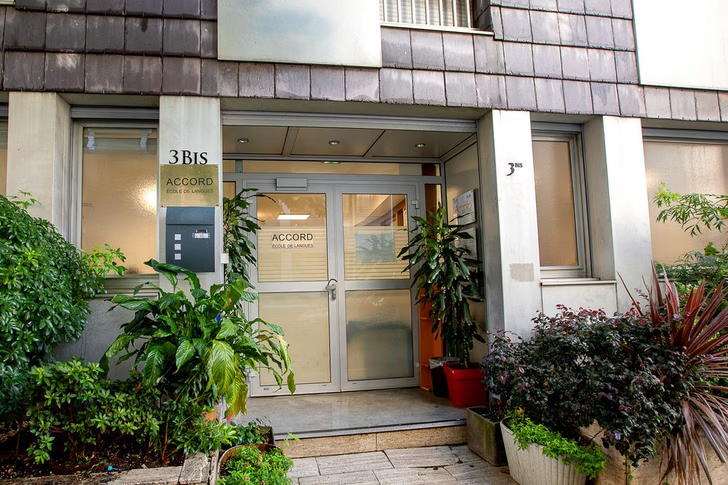
Accord
8.6- Max. 14 per class
- 2 min from the supermarket
What students say about Paris
Students who have studied in Paris give the city a very high score. The praise is practical: French is easy to practise in daily life, and public transport is convenient. Reviewers also like having the Eiffel Tower, restaurants and cafés nearby, and several describe it as the true Parisian experience.
Commonly praised
- Ample opportunities to practise French in Paris
- Convenient public transport access
- Easy opportunities to practise French in daily life
- Enjoyed the true Parisian experience
- The location near the Eiffel Tower is convenient for exploring Paris.
- The Eiffel Tower, restaurants, and cafes are nearby
Day trips and weekends beyond Paris
Most of the region's best-known sights are a short train ride from the city. Versailles and Saint-Denis are the closest, and Saint-Denis fits into a half-day. Giverny, Fontainebleau and Provins need a full day, with regional trains and a shuttle or local bus at the far end. Giverny takes about 1h15 via Vernon. The Loire Valley, Normandy and Champagne are better saved for a weekend with a night away.
Places students often explore
Student life in Paris
Afternoons are where Paris does its teaching. Cafés, museums, riverside walks and public parks fill the hours after class, and all of that is close at hand. Beyond the classroom, Paris is an international capital with neighbourhood markets, terraces and public cultural events. Evenings run late, with bars, live music venues and long dinners across the central districts. Most students settle into one area and treat the rest as a short trip.
Getting to know the neighbourhoods
Le Marais
The covered Marché des Enfants Rouges sits here, which makes it a natural place for a slow lunch or a Saturday wander. Expect to share the pavements with plenty of other people.
Montmartre
The village character is the draw: Sacré-Cœur on the hilltop and museums close by. It feels like a small town set apart from the centre, and it suits students who want a quieter base to come home to.
Batignolles
Residential and village-like, with no landmark to queue for. It suits students who want an ordinary neighbourhood for daily errands and evenings in.
Latin Quarter
Close to the Seine and the Notre-Dame area, the Latin Quarter makes it easy to walk to other central sights.
Oberkampf
Known for a lively evening scene, with bars and street art on the walls. It is the area to head for when you want a night out with classmates.
What everyday student life looks like
- Cafés and restaurants across from the Eiffel Tower
- Free afternoons for museums, parks and riverside walks
- Walks around the Champs de Mars with your class
- Cycling network and public bike facilities
Practising French on the streets of Paris
In Paris, French is the language of the street, and daily errands give you plenty of openings to use it. A bakery queue, a market stall and a café counter each offer a short exchange with a clear purpose: ask for something, understand the answer, pay. Local clubs and neighbourhood events lead to longer conversations once you feel ready for them. One tip is worth acting on: pick a market such as Bastille, Aligre or Raspail, and make it your weekly stop. Order your fruit and cheese in French, and try adding one new question each visit. It is a small routine, and it gives you real conversations to bring back to class the next morning.
What a week in Paris costs
from
€ 585 / week
Course + room at the same school, for a 2-week booking. Excluding flights.
Courses
per week, from- Conversation Courses 8 group lessons a week, fixed start dates
- € 195
- General Long Term Courses 20 group lessons a week, fixed start dates, from 25 weeks
- € 260
- Exam Preparation Courses 8 group lessons a week, fixed start dates
- € 290
- Grammar Courses 12 group lessons a week, fixed start dates
- € 290
- Afternoon Courses 20 group lessons a week, fixed start dates
- € 300
- General Courses 20 group lessons a week, fixed start dates
- € 405
- General + Focus Courses 26 group lessons a week, fixed start dates
- € 485
- General + Private Courses 26 group lessons a week, plus 5 private lessons, fixed start dates
- € 940
- Business Courses 20 group lessons a week
- € 1,550
Accommodation
per week, from, own room- Host Family own room, breakfast included
- € 390
- Aparthotel own studio
- € 720
- Hotel own studio
- € 930
From-prices apply to a 2-week booking outside high season. Book longer and the weekly price drops. Registration fee and materials are not included.
Paris is the priciest of the French cities students usually weigh up, and rent and eating out are the main reasons. Central-city services add to the bill. Your housing choice, how often you sit on a café terrace and how you get around will shape your budget more than anything else.
Lower-cost lunch menus and bakeries are where students spend less. Make them your midday habit and keep restaurant dinners for occasions.
Things to do in Paris
Step out of class and Paris offers a museum queue, a market stall, a park bench and a terrace with an empty table, often within a few minutes of each other. Which activities run depends on the language school, the season and your travel dates, and many of the best ones you can arrange yourself. Culture, food, music and green space all sit close at hand.
What to do, by interest
The Louvre, Musée d'Orsay, Centre Pompidou and Musée Carnavalet give you a different museum for every rainy afternoon. Musée du Quai Branly and Les Invalides, with Napoleon's tomb, sit close to the Eiffel Tower. Add Notre-Dame and Sainte-Chapelle for history. The banks of the Seine are UNESCO-listed, and street art turns up across several districts.
Browse the open-air stalls at Marché Bastille, the covered Marché des Enfants Rouges in the Marais, Marché d'Aligre or Marché Raspail, which has an organic market on Sundays. Between market visits, work through the bakery classics: baguette, croissant and macaron. Order a croque-monsieur or French onion soup at a neighbourhood bistro. Baguette craft is on UNESCO's intangible heritage list, so it deserves careful tasting.
Café terraces are where Paris meets friends, and bars and live music venues stay busy into the evening. On 21 June, the Fête de la Musique fills streets, squares, terraces and gardens with free performances across the city.
Paris has more than 500 green spaces. The Champs de Mars and the Trocadéro gardens are a short walk from the Eiffel Tower. For more room, Bois de Vincennes and Bois de Boulogne are large wooded parks you can walk or cycle through. The Seine riverbanks suit an easy evening stroll, and boat trips show the city from the water. Cycling is well supported, with an extensive network and public bike facilities.
Best time to study in Paris
May and June are the best months to arrive. Daytime highs climb from about 20°C to nearly 24°C, and the rainy days drop from nine in May to eight in June, which suits the free afternoons after morning lessons. July and August are the warmest, with highs around 26°C and July the driest month at seven rainy days. September stays mild, with highs above 21°C. Giverny is a seasonal spring-to-autumn visit, so schedule that day trip within those months. Winter is the cold stretch: January highs sit below 8°C, and December has 11 rainy days, the most of any month. The Paris Christmas markets are the reason to book then, so bring a waterproof.
Month by month
| Month | Avg high | Avg low | Rainy days |
|---|---|---|---|
| January | 7.8°C | 3.4°C | 10 |
| February | 9°C | 3.5°C | 9 |
| March | 13°C | 5.8°C | 10 |
| April | 16.8°C | 8.1°C | 9 |
| May | 20.4°C | 11.3°C | 9 |
| June | 23.6°C | 14.4°C | 8 |
| July | 25.9°C | 16.4°C | 7 |
| August | 25.8°C | 16.2°C | 8 |
| September | 21.7°C | 13.2°C | 8 |
| October | 16.7°C | 10.1°C | 10 |
| November | 11.3°C | 6.4°C | 10 |
| December | 8.2°C | 4°C | 11 |
How to get to Paris and get around
Three airports serve Paris, and each has its own way in. The RER B connects Charles de Gaulle (CDG) with Paris in about 25 to 30 minutes, and the Roissybus leaves from Place de l'Opéra. Orly (ORY) is linked by Metro line 14, a full-line journey of about 40 minutes, or by RER B to Antony and then the Orlyval. Beauvais (BVA) has dedicated airport coaches to the city. Once you are in Paris, walking accounts for 56% of trips within the city, helped by pedestrian streets, meeting zones and riverside paths. Public transport accounts for 31% of trips within Paris. A dense network of metro, RER, bus and tram lines connects central Paris and the surrounding suburbs. Single fares are fixed, and weekly and monthly passes are available. The city also has an extensive cycling network and public bike facilities.
Getting there: common questions
Is Paris safe? What students should know
Paris is generally regarded as a place where students study without trouble, with the caveats of any big European capital. Pickpocketing is the routine one, mostly on crowded metro and RER trains, in stations and around the main landmarks. Tourist scams are reported in the Latin Quarter and around Notre-Dame. Strikes and demonstrations can also disrupt transport.
Good to know before you go
- No one can promise safety anywhere. Read "considered safe" as how visitors generally experience the place, not as a guarantee.
- Take the normal precautions you would in any unfamiliar place, especially at night and in busy tourist areas.
- Check your government's official travel advice for the destination before you travel.
- Arrange your own comprehensive travel and health insurance for your stay.
Shops, food and opening hours in Paris
Shopping in Paris follows a weekly rhythm. Many shops close or shorten their hours on Sundays, so do your main shop earlier in the week. Food markets run on set weekdays, in the morning or during the day. Marché Bastille opens on Sunday mornings, and Marché Raspail adds an organic market that day. Supermarkets and convenience groceries cover household basics, and the markets are the place for fresh produce. Neighbourhood cafés and bistros serve weekday lunch menus and daily dishes.
-
Pharmacies are widespread across the city
-
Student restaurants and university dining hallsSubsidised meals for eligible students
-
Weekday lunch set menus at neighbourhood bistros
-
Open-air and covered food marketsFresh produce and groceries
Frequently asked questions about studying in Paris
See courses, prices and reviews, and book directly.
Not sure yet? Ask our language travel advisors, free of charge